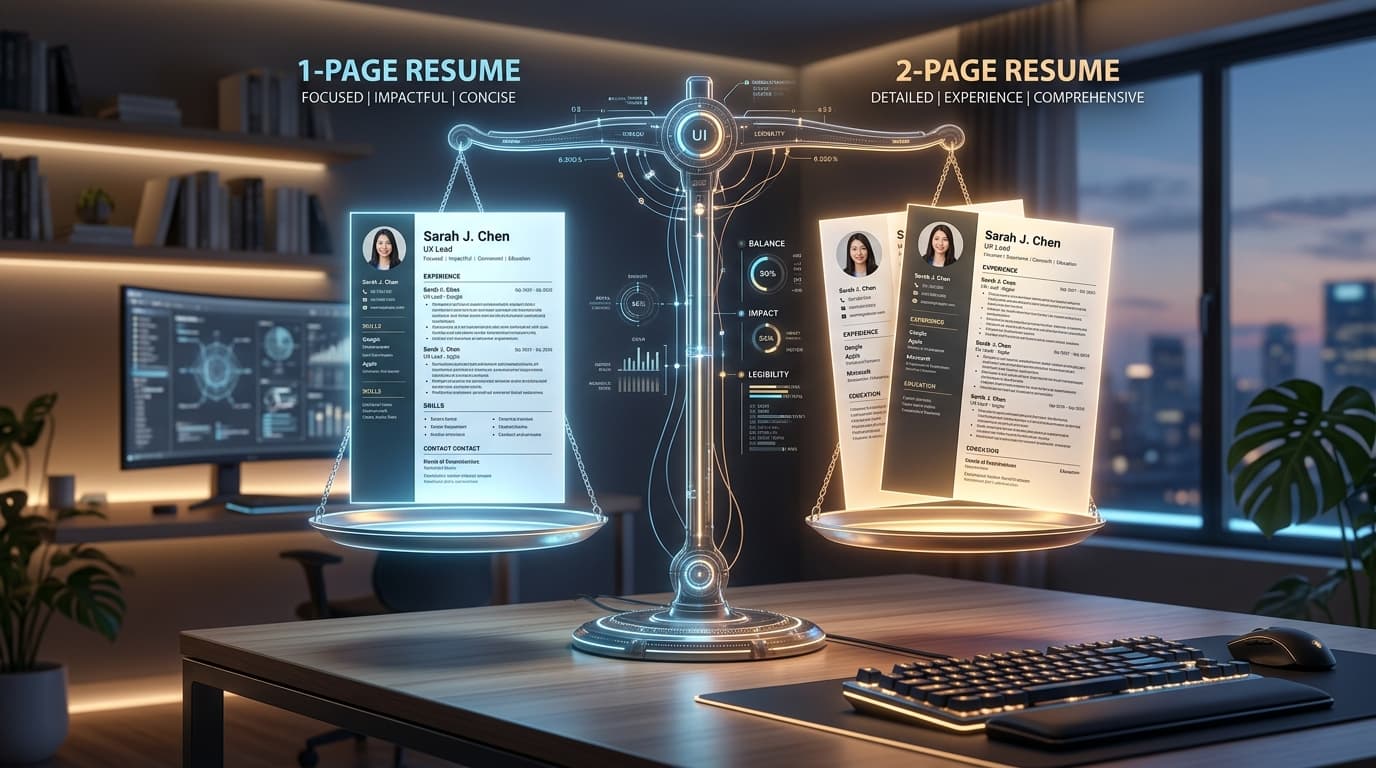
The debate over resume length is one of the most contentious and misunderstood topics in professional career development. For decades, conventional career dogma insisted on a rigid, unyielding commandment: "Your resume must fit on a single page, no matter what."
Yet today, senior corporate recruiters, executive search partners, and engineering directors routinely interview candidates whose two-page resumes landed six-figure compensation packages. At the same time, college freshers submitting two-page resumes are rejected within seconds for bloated padding.
So what is the definitive, data-backed truth in 2026?
Your ideal resume length is determined entirely by your years of relevant experience, your industry sector, and your content density. An ATS does not reject a resume based on page count—but human hiring managers ruthlessly penalize poor prioritization, document whitespace errors, and unnecessary fluff.
This comprehensive guide breaks down the latest recruiter research on document length, establishes the definitive tenure decision matrix, analyzes the psychology behind the fatal "1.25-page disaster," reveals step-by-step techniques to cut or expand your document, and details regional international standards.
The Definitive Resume Length Decision Matrix
Before adjusting your margins, locate your exact career profile in this operational matrix:
| Target Page Length | Target Candidate Profiles | Key Rationale & Scope |
|---|---|---|
| Strictly 1 Page | • College freshers and recent graduates (0–2 years)<br>• Early-to-mid career professionals (under 7 years tenure)<br>• Career switchers pivoting into a new technical field | Concentrates your strongest verified achievements into a single scan. Prevents weak filler and passes 7-second recruiter scans. |
| Strictly 2 Pages (Dense) | • Mid-to-senior professionals (8 to 15+ years tenure)<br>• Candidates with 4+ substantial roles and multi-system tech stacks<br>• Engineering managers, Staff Architects, and Directors | Provides sufficient space for deep architectural scope, team leadership metrics, and patent/publication records without spilling onto page 3. |
| 3+ Pages (Academic CV) | • Academic researchers, postdocs, and university faculty<br>• Medical doctors, clinical specialists, and healthcare researchers<br>• Federal/public-sector roles requiring exhaustive compliance records | These are formal Curriculum Vitae (CVs), not commercial industry resumes. Completeness takes precedence over brevity. |
| Career Stage | Target Length | Core Formatting Objective | Fatal Mistake to Avoid |
|---|---|---|---|
| Freshers & Undergrads | Strictly 1 Page | Showcase education, capstone projects, core tools, and campus leadership. | Stretching content to 1.5 pages using huge fonts and double spacing. |
| Early Career (2–5 Years) | Strictly 1 Page | Detail 1 to 2 professional roles with quantified Google XYZ business wins. | Including ancient high school honors, sports, or unrelated summer jobs. |
| Mid-Career (6–9 Years) | 1 or 2 Pages | Showcase career progression, promotion velocity, and expanding technical scope. | Allowing 5 stray lines to spill onto page 2, leaving 80% white space. |
| Senior & Leads (10–15 Years) | Exactly 2 Pages | Highlight multi-team leadership, architectural vision, P&L, and enterprise ROI. | Writing an unedited 4-page career autobiography documenting every task since 2005. |
| C-Suite & Executives (15+ Years) | Exactly 2 Pages | Strategic governance, board stewardship, corporate M&A, and market valuation. | Listing detailed tactical coding or entry-level bullet points from 20 years ago. |
The "1.25-Page Disaster": why orphan pages kill applications
The single most destructive formatting blunder in modern resume writing is submitting a document that spills 4 to 10 stray lines onto a second page:
PAGE 1: [Dense, professional text covering 100% of the canvas]
PAGE 2: [4 lone lines: 1 certification and 2 references, with 85% empty blank space]
Why Recruiters Hate the 1.25-Page Resume:
- Perception of Executive Incompetence: It signals that the candidate cannot edit their thoughts, lacks spatial awareness, and cannot prioritize high-impact information within boundaries.
- The Printing Hazard: In final-round panel interviews, hiring managers frequently print paper copies of resumes. A second page containing four lines often gets separated, misplaced, or looks like a printer misfire.
- Weak Closing Impression: The last visual impression an interviewer sees is an empty white void, diluting the perceived authority of your application.
The Inflexible Formatting Rule: Either create a tight, compelling 1-page resume, or create a comprehensive, balanced 2-page resume where page 2 is at least 65% to 75% full.
How to cut your resume down to one page: 5 tactical levers
If your draft is currently 1.25 to 1.5 pages long, use these tactical editing techniques to achieve a clean single page without deleting high-value achievements:
| Optimization Lever | Target Setting & Action Item | Practical Impact on Page Length |
|---|---|---|
| 1. Geometry Lever | Set margins to 0.5" (36pt) on all four borders | Reclaims up to 18% printable surface area compared to 1" defaults. |
| 2. Typography Lever | Set body text to 10pt with 1.1x–1.15x line spacing | Compacts vertical line pitch without sacrificing readability. |
| 3. Orphan Word Hunt | Edit lines with trailing 1–2 words wrapping to a second line | Pulling orphan words up saves an entire vertical line per bullet. |
| 4. Header Compaction | Condense multi-line contact stack into 1 piped horizontal row | Frees up 3–4 lines of premium top-third real estate. |
| 5. Content Pruning | Enforce 10-year rule; purge outdated high-school or secondary tasks | Removes irrelevant historical baggage that dilutes modern technical focus. |
1. Document Geometry Optimization
- Standard word processor margins are set to 1 inch. Reduce your top, bottom, left, and right margins to 0.5 inches (36pt). This instantly adds nearly 20% more printable canvas.
- Adjust paragraph spacing after bullet points to 2pt or 3pt instead of a full blank line.
2. Typography & Hierarchy
- Set body text to 10pt or 10.5pt in an efficient, clean font (e.g., Calibri, Inter, Arial, Roboto).
- Ensure section headings remain distinct at 12pt to 13pt bold.
- Never drop body font below 9.5pt; text smaller than 9.5pt causes eye strain during human review.
3. The "Orphan Word" Hunt
Scan every bullet point on your resume. If a bullet point wraps onto a second line with only one or two words (e.g., "...system reliability."), edit the sentence to trim three words. Pulling that orphan line up saves an entire vertical line of space. Doing this across four bullets saves nearly an inch of vertical page height!
4. Compact Piped Contact Header
Never stack your contact details on separate vertical lines. Format your header as a clean, horizontal piped block:
AADITYA HRIDAY | Senior Backend Engineer | Pune, India
adi@resumecopy.com | +91 98765 43210 | github.com/aadityahriday | linkedin.com/in/aaditya-hriday
5. Content Pruning & Deletions
- Delete "References available upon request": Hiring managers already know they can ask for references; listing this wastes valuable space.
- Delete High School Details: If you have completed college or have 2+ years of professional tenure, delete high school education entirely.
- Consolidate Early Career: Summarize roles older than 10 years into a single-line summary: "Prior Experience: Software Engineer at Infosys (2012–2014); Junior Developer at Wipro (2010–2012)."
When and how to expand to two pages properly
If you have 8 to 15+ years of senior experience, cramping your career into a microscopic 8.5pt single-page document is equally dangerous. It forces you to delete major commercial achievements and turns your resume into an impenetrable, unreadable block of tiny text.
The Anatomy of an Executive 2-Page Resume:
When expanding to two pages, adhere to these structural rules:
- Page 1 Focus:
- Contact Header & Professional Headline
- 3-Sentence Professional Summary
- Core Technical / Leadership Competencies Matrix
- Most recent 2 positions (with 4 to 6 detailed Google XYZ accomplishment bullets each)
- Page 2 Focus:
- Prior professional positions (condensed to 2 to 3 bullets each)
- Significant Production Projects or Board Affiliations
- Education, Cloud Certifications, and Patents
- The Page 2 Header Rule:
- At the top of Page 2, always include a discreet, right-aligned secondary header:
Aaditya Hriday | Senior Backend Engineer | Page 2 of 2- This ensures your document remains organized if physical pages are separated.
International standards: US vs. UK vs. India vs. Global
Resume length expectations vary substantially across geographic jurisdictions:
| Jurisdiction | Preferred Nomenclature | Standard Document Length | Key Regional Conventions |
|---|---|---|---|
| United States & Canada | Resume | 1 Page (Under 7 yrs); 2 Pages (8+ yrs) | Strictly NO photos, NO marital status, NO dates of birth (EEOC compliance). |
| United Kingdom & Ireland | CV (Curriculum Vitae) | Standard 2 Pages | Two pages is the default expectation for most corporate professionals. |
| India (Corporate Tech & MNCs) | Resume | 1 Page (Freshers/Mid); 2 Pages (Senior) | Modern corporate IT and startups follow US single-page ATS standards. Avoid multi-page biodata. |
| India (Government / Traditional) | Biodata | 2 to 4 Pages | Tabular layout, personal declaration clauses, father's name, DOB (used for PSC/PSU). |
| European Union (Continental) | CV | 1 to 2 Pages | Europass standard slowly giving way to clean, modern single/two-page formats. |
| Australia & New Zealand | Resume / CV | 2 to 3 Pages | Australian recruiters prefer slightly more descriptive task context. |
For Indian candidates deciding between corporate and government formats, read our deep-dive comparison: Biodata vs Resume vs CV.
Frequently Asked Questions
Does an ATS automatically penalize or reject a two-page resume?
No. Applicant Tracking Systems parse text streams linearly into a database. An ATS does not care whether your text was extracted from one page or two pages. However, human recruiters do care. An unnecessarily long, padded resume frustrates recruiters and dilutes your core achievements.
Can a fresher with strong college projects justify a two-page resume?
No. In 99% of cases, freshers submitting two-page resumes are padding their document with high school history, generic hobby lists, or huge fonts. Condense your academic projects into tight Google XYZ bullets and keep your document strictly to one page. Explore our Resume Format for Freshers Guide.
How do I check if my resume formatting passes ATS parsing?
Upload your document to ResumeCopy's Free ATS Resume Checker. It checks your page boundaries, analyzes text selectable vectors, and confirms that your formatting decompiles cleanly.
Should I print my resume single-sided or double-sided for interviews?
For on-site interviews, print your two-page resume on two separate sheets of high-quality paper, fastened with a clean paperclip (never a staple). Include your name and Page 2 of 2 on the second sheet.
What should I do if my resume is 1 page and 3 lines?
Apply the 5 Cutting Levers immediately: tighten margins to 0.5 inches, reduce font size to 10pt, eliminate orphan words, and condense your header. You will easily pull those three lines onto page 1 in under two minutes.
Verified Research & Sources
- ResumeLab Recruiter Survey: Recruiter Reading Times, Page Count Preferences, and Candidate Selection Rates Across 1,000+ Hiring Managers.
- National Association of Colleges and Employers (NACE): Standards for Undergraduate and Entry-Level Career Documents.
- Society for Human Resource Management (SHRM): Resume Screening Efficiency and Information Density Standards in Talent Acquisition.
- Harvard Business School Career Advisory: Document Design and Spatial Architecture for Technical and Executive Resumes.
Research & Editorial Verification Sources
Every statistic, parsing benchmark, and formatting rule in this guide is cross-checked against primary institutional research and our open-source parser test suite:
- National Association of Colleges and Employers (NACE): Job Outlook 2026 & Career Readiness Competencies — employer screening rubrics, internship weighting, and skills-first evaluation data.
- Harvard FAS Mignone Center for Career Success: Create a Resume, CV, or Cover Letter — action-verb bullet architecture and chronological formatting standards.
- MIT Career Advising & Professional Development (CAPD): Resume & Impact Metric Guidelines — engineering project quantification and Google XYZ accomplishment frameworks.
- Society for Human Resource Management (SHRM) & Greenhouse: Enterprise Talent Acquisition & Structured Hiring Benchmarks — how human recruiters query and filter ATS candidate databases.
- ResumeCopy Open-Source Parser Benchmark (2026): Reproducible 30-Resume ATS Benchmark Dataset — empirical token extraction accuracy and reading-order fidelity across
pdf-parse,pdfjs-dist, andmammoth.