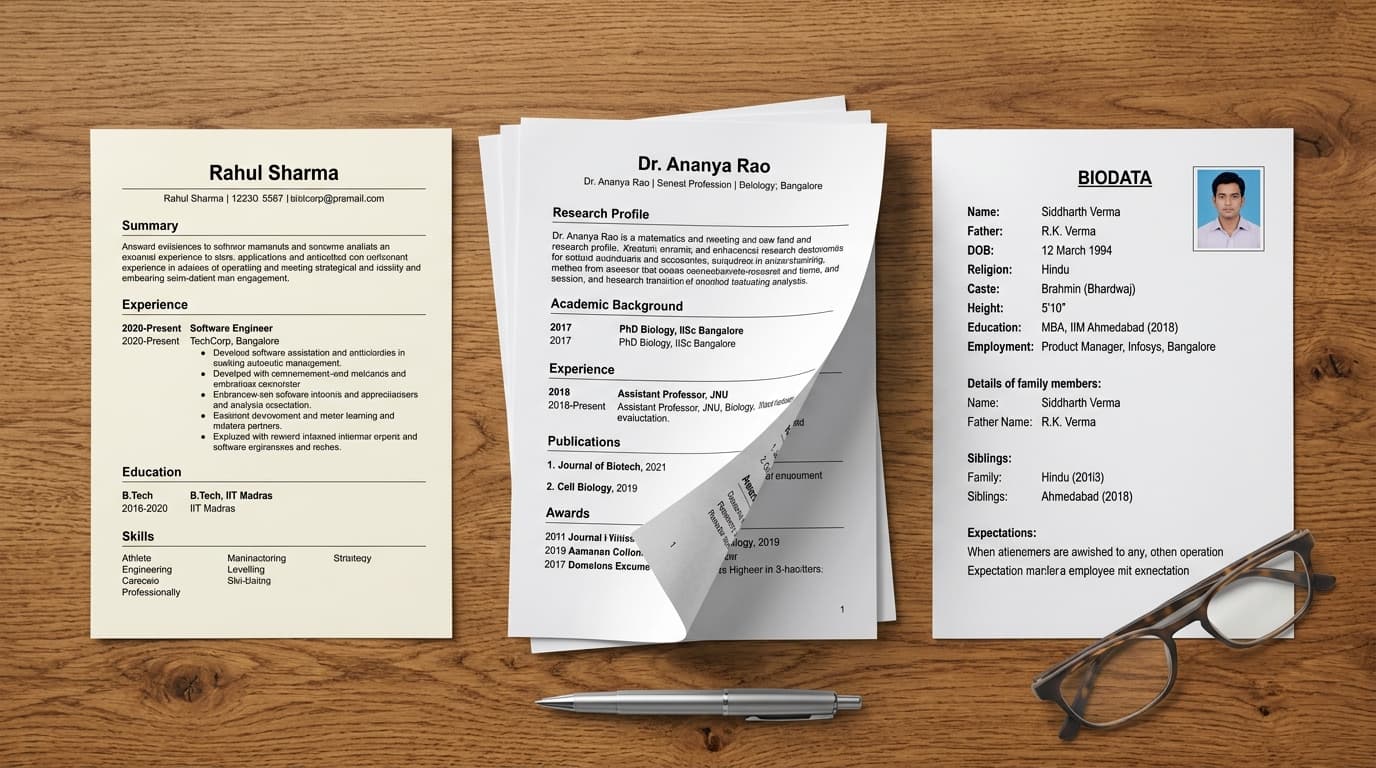
In India, job applicants frequently use the words "resume," "CV," and "biodata" as if they are interchangeable synonyms. Sending the wrong document to a corporate hiring manager or an automated portal is one of the fastest ways to get rejected before an interview is even scheduled.
If you send a 4-page biodata filled with your father's name and marital status to a software startup, it will be discarded as outdated. Conversely, if you submit a one-page tech resume for an Indian government PSU gazetted officer post or an academic research fellowship, your application will be disqualified for missing statutory background disclosures.
This guide provides the exact criteria to determine whether you need a resume, a CV, or a biodata, including an employer-by-employer decision chart and a 10-minute guide to converting an outdated biodata into a modern ATS-friendly resume.
The 30-second answer: comparison table
A resume is a concise, 1-page summary of your relevant skills, projects, and work experience tailored to a specific private-sector job. A CV (Curriculum Vitae) is an exhaustive, multi-page record of your complete academic history, publications, teaching appointments, and research grants. A biodata (Biographical Data) is a factual government, defence, or matrimonial document emphasizing personal, demographic, and familial details.
The table below contrasts the three documents across crucial hiring dimensions in India:
| Feature | Resume | Curriculum Vitae (CV) | Biodata (Biographical Data) |
|---|---|---|---|
| Primary Purpose | Secure interviews in the private corporate sector | Document scholarly, medical, or research career | Government hiring, defence, matrimonial, clerical |
| Document Length | Strictly 1 page (rarely 2 for 10+ years experience) | 3 to 10+ pages (grows with your career achievements) | 1 to 3 pages (standardized tabular form) |
| Personal Information | Name, phone, email, city, LinkedIn/GitHub | Name, contact details, professional affiliation | Date of birth, gender, marital status, father's name, religion, caste |
| Focus of Content | Specific job-targeted accomplishments & skills | Comprehensive academic history, publications, grants | Verified chronological facts, physical traits, character references |
| Design & Layout | Clean, single-column, ATS-optimized typography | Conservative, formal, detailed chronological listing | Tabular grid layout with photo box |
| ATS Readability | High (95%–100%) when built single-column | Moderate (often reviewed manually by academic committees) | Low (nested tables scramble in modern enterprise parsers) |
| Common Indian Employers | IT Services (TCS, Infosys), MNCs, Startups, Banks | Universities (IIT, IIM, AIIMS, IISc), Research Labs (ISRO, DRDO) | State PSCs, UPSC offline forms, Police forces, Marriage portals |
What is a resume?
A resume (derived from the French word for "summary") is a tightly curated marketing document designed for the private sector. Its sole purpose is to prove to a recruiter or automated applicant tracking system (ATS) that your specific competencies match an open job description.
A modern resume is strictly competency and achievement-focused. It does not list everything you have ever done in your life; rather, it cherry-picks your most relevant projects, tools, metrics, and education. If you are applying for a Junior Frontend Developer position, your resume will highlight React, JavaScript, and UI performance, while omitting unrelated high school debates or casual retail chores.
Key characteristics of a modern resume:
- One page in length: In 2026, recruiters spend approximately 6 seconds on initial candidate screening. One page forces brevity and high signal-to-noise ratio.
- Targeted to the job description: Requisition keywords from the job ad are mirrored naturally in your experience and skills sections.
- Quantified bullet points: Accomplishments follow the Google XYZ formula: "Accomplished [X], as measured by [Y], by doing [Z]".
You can generate a tailored, single-column resume using our Free AI Resume Builder or explore tested layouts in our ATS Resume Templates library.
What is a CV (and why its definition differs globally)?
The term Curriculum Vitae (Latin for "course of life") represents a comprehensive biographical document tracking a professional's full academic and scholarly journey.
However, the word "CV" causes significant confusion in India due to international linguistic differences:
- In the United States & Canada: A "resume" is the standard 1-page corporate document. A "CV" is strictly an exhaustive academic dossier used only by professors, medical doctors, scientists, and researchers applying for tenure, grants, or post-doctoral fellowships.
- In the United Kingdom, Europe & South Africa: The word "CV" is commonly used as a synonym for what Americans call a resume. European corporate job postings will say "Please submit your CV," but they still expect a concise 1 to 2-page targeted document.
- In India: Job postings frequently say "Send your CV/Resume." When an Indian IT firm, private bank, or corporate startup asks for your "CV," they actually want a 1-page ATS resume, not an academic research dossier.
An authentic academic or medical CV includes sections that never appear on a corporate resume:
- Peer-reviewed journal publications and citations
- Conference presentations and keynote speeches
- Research grants, patent filings, and clinical trials
- Teaching appointments, curriculum development, and graduate student advising
- Institutional committee memberships and editorial board roles
If you are an academic or medical professional, review our dedicated guide to Academic CV Formats & Templates.
What is a job biodata?
A biodata (short for Biographical Data) is a legacy Indian administrative format that originated in the colonial era and remains deeply embedded in the public sector. Unlike a resume, which emphasizes your workplace achievements, a biodata emphasizes your personal background, legal identity, and statutory eligibility.
In a biodata, candidates are required to disclose demographic and personal characteristics that are strictly illegal for private employers to ask under Western labor laws:
- Date of birth, exact age, and place of birth
- Gender, nationality, and marital status
- Father’s name and mother’s name
- Category or caste reservation status (General, OBC, SC, ST, EWS)
- Physical attributes (height, weight, vision status for police and military roles)
- Permanent residential address and local police station jurisdiction
- Formal declaration statement signed by hand with date and location
Where is biodata still used in India?
Biodatas are still required in three distinct scenarios:
- Government & PSU recruitment: Certain state public service commissions, clerical administrative roles, and public sector banks still require candidates to fill out physical or tabular biodata forms to verify age limits and statutory caste reservations.
- Indian Armed Forces, Police, and Paramilitary: Physical standards, medical fitness, and parental background are statutory prerequisites under military recruitment boards.
- Matrimonial applications: In traditional arranged marriage matchmaking, families circulate a "marriage biodata" summarizing family lineage, gotra, astrological horoscope details, education, and profession.
Which one should you send? Decision chart by employer type
To eliminate all confusion, base your document choice on who is hiring, not on the casual vocabulary used in the job advertisement:
[WHERE ARE YOU APPLYING?]
       |
       +---> Private Corporate / IT Services / Startups (TCS, Infosys, Swiggy, Google)
       |     └──> SEND A RESUME (1 page, single-column, zero personal biodata details)
       |
       +---> Universities / Research Labs / Hospitals (IIT, IIM, IISc, AIIMS, CSIR)
       |     └──> SEND A CV (Multi-page, publications, grants, academic history)
       |
       +---> Government / PSU / Defence / State Civil Services (UPSC, SSC, Police)
       |     └──> SEND A BIODATA (Tabular, DOB, father's name, caste declaration)
       |
       +---> Gulf / Middle East Applications (UAE, Saudi Arabia, Qatar)
       |     └──> SEND A HYBRID RESUME/CV (2 pages, includes nationality, visa status, photo)
       |
       +---> Western Remote / US / UK Remote Companies
             └──> SEND A RESUME (Strictly 1 page, zero personal info, no photo, no DOB)
1. Private companies, IT services, and tech startups
If you are applying to private IT services companies (TCS, Infosys, Wipro, Cognizant), global tech giants, fintech startups, or Indian private corporations (Tata, Reliance, Mahindra), always submit a 1-page ATS-friendly resume.
Even if the HR email says "Kindly share your updated CV," sending a 3-page document with your father's name and high school hobbies will instantly mark you as an amateur. Read our pillar guide on Resume Format for Freshers in India for the exact section order recruiters expect.
2. Academic, research, and medical institutions
If you are applying for a Lecturer, Assistant Professor, Postdoctoral Researcher, or Medical Specialist post at institutions like IIT Bombay, IIM Ahmedabad, IISc Bangalore, or AIIMS, submit a comprehensive Curriculum Vitae (CV).
Academic search committees expect you to document every publication, grant received, journal peer-review assignment, and course taught. A 1-page corporate resume will be disqualified as grossly insufficient.
3. Government, PSU, and defence recruitment
If you are applying for state government administrative exams, clerical PSU positions, railway recruitment boards (RRB), or military officer selections, follow the official notification to the letter.
If the official recruitment notification provides an "Annexure A: Biodata Form," you must use their exact tabular template. Omitting requested personal details like father's name or date of birth will cause your application to be rejected during background scrutiny.
4. Gulf and international applications
For roles in Dubai, Abu Dhabi, Saudi Arabia, or Qatar, hiring practices differ from Western standards. Employers in the Gulf frequently request a "2-page Detailed CV" that includes your nationality, current visa status (e.g., Employment Visa, Visit Visa), languages spoken, and a professional passport-size headshot. This is because Gulf visa quotas and sponsorship processes are legally tied to nationality.
Turn your biodata into an ATS resume in 10 minutes
If you currently have a multi-page biodata created in Microsoft Word with tables, boxes, and personal details, follow this 5-step process to rebuild it into a high-scoring, private-sector ATS resume:
Step 1: Delete all demographic fields
Strip out the following lines immediately:
- Date of Birth (DOB) and Age
- Father's Name, Mother's Name, and Family Details
- Gender, Religion, Caste, and Nationality
- Marital Status
- Permanent Address, Village, District, and Pin Code
- Declaration statement and signature line
Step 2: Extract your content out of tables
Many Indian candidates create resumes inside complex Word tables with visible or invisible borders. When an ATS parser (like Taleo or Workday) parses a table, it reads cell by cell across horizontal rows, blending your dates into your skill names. Copy your text out of table grids and place it into clean, linear paragraphs with standard bullet points.
Step 3: Upgrade passive duties into Google XYZ bullets
Biodatas typically list passive duties: "Responsible for assisting in bank reconciliation." Transform these into quantified achievements: "Reconciled 150+ monthly vendor accounts in Tally Prime, identifying and rectifying ledger discrepancies worth ₹3.8 Lakhs with zero audit exceptions."
Step 4: Group technical tools into functional categories
Replace your unstructured "Skills Known" section with categorized skill groups: Programming Languages, Frameworks, Databases, and Developer Tools.
Step 5: Compress down to exactly one page
Adjust line spacing to 1.15, set uniform 0.5-inch margins, and select a clean vector font (Calibri, Arial, or Helvetica at 10.5pt). Test your newly converted document using our free ATS Resume Checker to verify that your contact info and projects parse cleanly.
Keep, remove, or only-if-asked: personal details checklist
Use this quick-reference matrix when deciding what personal information to print on your document:
| Detail | Status | Rationale |
|---|---|---|
| Full Legal Name | KEEP | Large bold font (16pt–18pt) at the top of page |
| Phone Number & Email | KEEP | Include India country code (+91); use clean professional email |
| Current City & State | KEEP | e.g., Bengaluru, Karnataka (alerts recruiters to relocation status) |
| LinkedIn & GitHub/Portfolio | KEEP | Clickable URLs providing proof of code or professional network |
| Full Postal Address | REMOVE | Poses identity theft risks and consumes 3 wasted lines |
| Date of Birth & Age | REMOVE | Irrelevant for private hiring; opens door to subconscious age bias |
| Gender & Marital Status | REMOVE | Zero bearing on technical job performance |
| Father's Name & Occupation | REMOVE | Legacy biodata habit; completely obsolete in corporate hiring |
| Religion & Caste | REMOVE | Never disclose on private-sector resumes (keep only on PSU quota forms) |
| Photograph (Headshot) | REMOVE | Stripped by ATS parsers; causes bias; keep only if applying in Gulf/Hospitality |
| Formal Declaration Clause | REMOVE | "I hereby declare that the above details are true..." is redundant on modern resumes |
For a comprehensive analysis of when photos, dates of birth, and declarations are legally required versus dangerous, see our deep-dive on Photo, Date of Birth, and Declaration on Indian Resumes.
Frequently Asked Questions
What is the main difference between a biodata, CV, and resume?
A resume is a concise 1-page summary of relevant skills and accomplishments tailored to a specific private job. A CV is a comprehensive, multi-page record of your entire academic and research career. A biodata is a biographical administrative form used primarily in Indian government, defence, or matrimonial contexts that emphasizes personal, familial, and demographic details.
Which one should freshers submit to private companies in India?
Freshers should always submit a 1-page ATS-friendly resume. Even if the job description casually asks candidates to "email your CV," private IT firms, banks, and startups expect a concise, single-column resume highlighting education, technical skills, and academic projects.
Is a biodata valid for private corporate jobs?
No. Submitting a traditional biodata with your father's name, date of birth, marital status, and a declaration clause will immediately signal to corporate hiring managers that you lack familiarity with modern professional standards. Convert your biodata into a modern single-column resume before applying.
Do Indian government and PSU jobs require a biodata or a resume?
Indian government and public sector undertakings (PSUs) generally require a standardized biodata form specified in their official recruitment gazette. This is necessary because government bodies must legally verify your age limits, category reservations (SC/ST/OBC/EWS), and state domicile eligibility.
Can I convert my biodata into a resume without rewriting everything?
Yes. Strip out personal and demographic sections (DOB, parents' names, marital status, religion), extract text from table grids into linear bullet points, format accomplishments using action verbs and metrics, and compress the document to a clean single page. You can use ResumeCopy's Free AI Resume Builder to format your content into an ATS-safe layout in minutes.
Primary Sources & Further Reading
- Cambridge University Careers Service: CV vs Resume: International Terminology and Format Distinctions (2025).
- Indian Institute of Technology (IIT) Placement Guidelines: Student Placement Cell Resume Standards & Single-Page Protocols (2025–2026).
- UPSC (Union Public Service Commission) Examination Rules: Candidate Verification and Biographical Disclosure Framework.
- Equal Employment Opportunity Commission (EEOC) / SHRM: Workplace Discrimination Guidelines Regarding Demographic Disclosures on Application Materials.