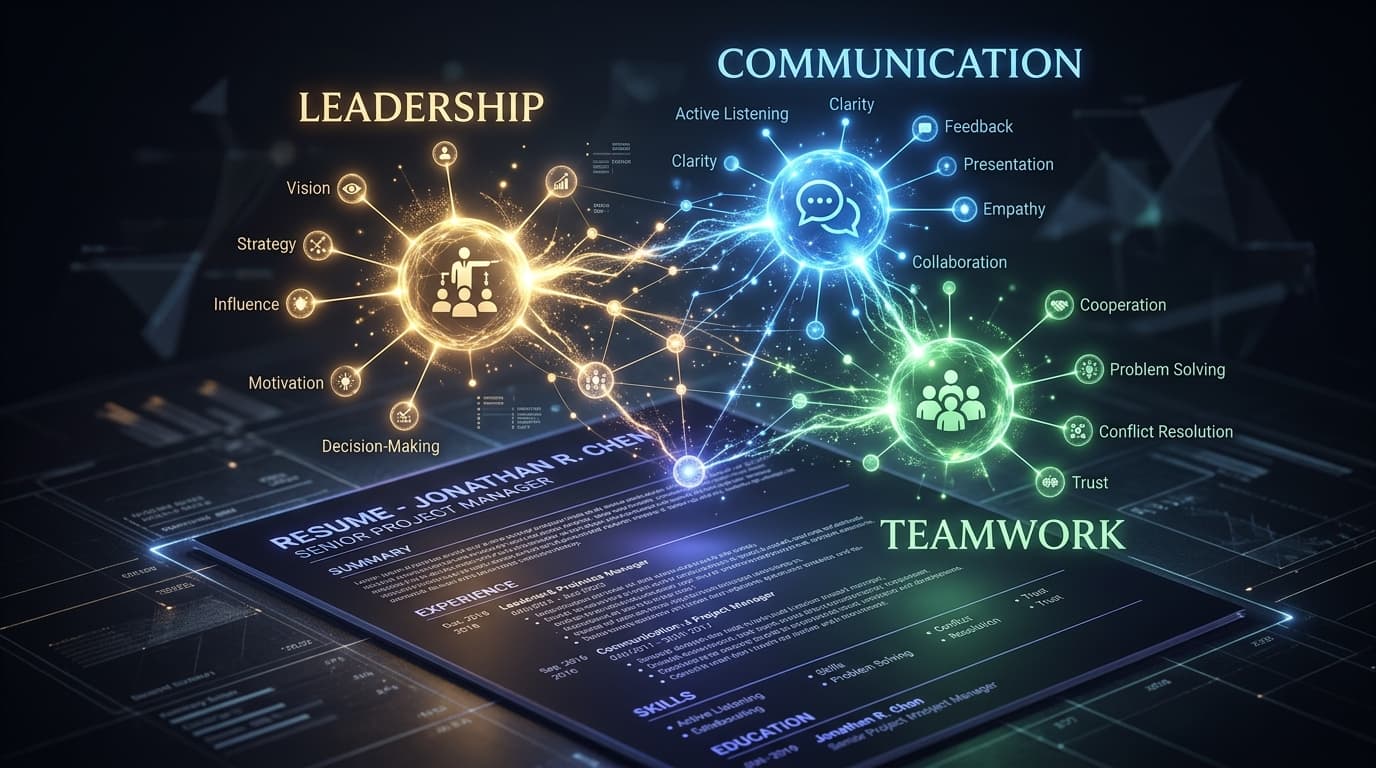
Listing "team player," "strong communicator," "critical thinker," and "detail-oriented" in a standalone bulleted list on your resume is actively hurting your job search.
Every single candidate writes those exact words. To a corporate recruiter reviewing 300 applications, an unverified list of soft skill adjectives is meaningless white noise that squanders prime real estate. Additionally, modern Applicant Tracking Systems (ATS) do not award ranking points for vague character traits.
Here is the paradox: Every major employer survey—from the World Economic Forum to LinkedIn Global Talent Trends—confirms that soft skills (communication, adaptability, leadership, and emotional intelligence) account for over 80% of long-term career success and executive promotion velocity.
Employers care deeply about soft skills. But they do not believe them when you simply type the adjective.
Soft skills cannot be stated; they must be proven through context, operational behavior, and measurable business outcomes.
This comprehensive guide reveals why soft skill lists fail, outlines the Context-Behavior-Metric (CBM) formula, provides a master translation matrix across eight core competencies, shows you how to quantify non-numeric roles, and delivers spoken interview scripts to ace behavioral panel rounds.
Why the "Soft Skills List" Fails Both ATS and Human Recruiters
Look at the typical soft skills section found on 95% of rejected resumes:
[THE REJECTED BUZZWORD DUMP]
• Hardworking, punctual, and highly self-motivated
• Excellent verbal, written, and interpersonal communication
• Strong team player who thrives in competitive collaborative environments
• Critical problem solver with exceptional multitasking capabilities
Why Recruiters Immediately Dismiss This:
- Zero Evidence: Typing "detail-oriented" takes 3 seconds and requires zero skill. In fact, recruiters report that resumes claiming to be "detail-oriented" frequently contain formatting typos!
- Zero Differentiation: When every applicant claims to be an "excellent communicator," the phrase ceases to carry informational value.
- ATS Invisibility: ATS algorithms like Workday and Greenhouse prioritize hard technical skills (nouns, tools, languages) and active leadership verbs. Generic adjectives are treated as low-weight stopwords.
The Context-Behavior-Metric (CBM) Formula
To make a soft skill undeniable, embed it directly into your professional experience bullets using the Context-Behavior-Metric (CBM) Formula:
[1. CONTEXT & STAKEHOLDERS] The complex situation, team scale, or organizational friction
• [2. BEHAVIORAL ACTION] The specific soft skill deployed (negotiation, mentorship, alignment) • [3. QUANTIFIABLE OUTCOME] The business result (hours saved, revenue retained, deadlines met)
| 1. CONTEXT | 2. BEHAVIOR (SOFT SKILL) | 3. QUANTIFIED OUTCOME |
|---|---|---|
| 3 Disputed vendors | Negotiated SLA and price terms | trimming annual spend by $64k |
| 4 Junior developers | Mentored via weekly 1-on-1s | accelerating velocity by 35% |
| Conflicting PMs | Facilitated roadmap alignment | shipping Q3 release on-time |
| Remote team of 16 | Authored asynchronous RFC docs | cutting weekly syncs by 4 hrs |
Generate customized CBM bullets with our AI Bullet Point Generator.
Master Translation Matrix: proving 8 core soft skills
Use this tactical matrix to translate abstract soft skills into bullet-proof resume achievements:
| Soft Skill to Prove | The Weak Adjective (Fails) | High-Impact Operational Transformation (Wins) | Core Competency Demonstrated |
|---|---|---|---|
| Communication | "Strong communicator who works well with clients." | "Delivered 24 quarterly business reviews (QBRs) to C-level client executives, sustaining a 94% contract renewal rate across $3.8M in annual recurring revenue." | Executive presentation capability and commercial retention. |
| Leadership & Mentorship | "Great team leader and mentor to colleagues." | "Mentored 5 junior software engineers through weekly 1-on-1 code reviews and system design sessions, contributing to 2 internal promotions within 12 months." | Talent cultivation, team empowerment, and engineering culture. |
| Cross-Functional Collaboration | "Team player who collaborates across departments." | "Partnered with Product, Engineering, and Legal teams across 3 time zones to launch a GDPR-compliant billing service within an aggressive 90-day sprint deadline." | Navigating corporate silos, stakeholder alignment, and execution speed. |
| Problem Solving & Adaptability | "Excellent problem solver under high pressure." | "Diagnosed a critical database deadlocking bottleneck during a high-visibility production outage, restoring transaction throughput within 18 minutes." | Crisis composure, technical root-cause analysis, and resilience. |
| Time Management & Organization | "Highly organized and able to multitask." | "Managed concurrent rollouts of 6 enterprise client implementations simultaneously, achieving 100% on-time milestone delivery with zero budget overruns." | Multi-project governance, prioritization, and budget discipline. |
| Negotiation & Conflict Resolution | "Strong negotiation and persuasion skills." | "Mediated contentious contract terms across 3 third-party cloud vendors, renegotiating SLA commitments while trimming annual licensing spend by $82,000." | Commercial diplomacy, financial acumen, and assertiveness. |
| Asynchronous Remote Discipline | "Independent self-starter who works well remotely." | "Authored 16 architectural RFC design docs and API integration wikis in Notion, eliminating 6 weekly meeting hours across an 18-person distributed team." | Written documentation rigor and low management overhead. |
| Customer Empathy & Active Listening | "Deeply empathetic toward customer needs." | "Conducted 45 qualitative user discovery interviews to diagnose friction in onboarding funnel, translating user feedback into 4 UI redesigns that lifted conversion by 22%." | Translating human emotion into technical product requirements. |
The Non-Metric Substitution Guide: how to quantify without revenue
Many professionals—especially in HR, customer support, healthcare, education, and administration—struggle because they do not have direct access to corporate sales or dollar revenue figures.
You do not need dollar signs to prove soft skills. Use these 5 Alternative Metric Levers:
5 ALTERNATIVE METRIC LEVERS
• 1. TIME / EFFICIENCY: Hours saved per week, turnaround time reduction • 2. VOLUME / THROUGHPUT: Number of tickets, users, students, or reviews • 3. ACCURACY / ERROR RATE: Defect drop %, compliance %, SLA uptime • 4. STAKEHOLDER REACH: Number of team members, clients, or departments • 5. RETENTION & SATISFACTION: CSAT scores, NPS ratings, renewal rates
- Customer Support: "Resolved 65+ complex customer escalation cases daily, lifting individual CSAT rating from 88% to 98.2% over 6 months." (Proves: Patience & Conflict Resolution).
- Office Administration: "Re-engineered weekly office procurement workflows, reducing supply reordering turnaround from 5 business days to 24 hours." (Proves: Organizational Efficiency).
- Academic Teaching: "Instructed 120 undergraduate students in laboratory physics, with 94% of students passing practical exams on their first attempt." (Proves: Pedagogical Communication).
Learn more metric strategies in our guide on How to Quantify Resume Achievements.
Role-specific soft skill transformations
1. Software Engineering & Data
- Weak: "Good team player who takes code reviews seriously."
- High-Impact: "Conducted thorough, empathetic code reviews for 140+ GitHub pull requests, establishing automated linting guidelines that cut subsequent PR review iterations by 40%."
2. Marketing & Brand Strategy
- Weak: "Creative thinker with strong presentation skills."
- High-Impact: "Pitched a repositioning strategy to executive stakeholders, securing a $150,000 incremental Q3 budget that generated 850 inbound enterprise leads."
3. College Freshers & Student Leadership
- Weak: "Active member of student council and great leader."
- High-Impact: "Chaired university cultural festival logistics committee, managing 35 student volunteers, coordinating 14 vendor contracts, and hosting 2,200 attendees with zero safety incidents."
Behavioral interview scripts: defending soft skills on camera
During your interview rounds, hiring managers will probe your claimed soft skills using behavioral questions: "Tell me about a time you had a serious disagreement with a coworker or manager."
Deliver this structured response using the Spoken STAR Method:
"In my previous role at NexaCorp, our Lead Designer and I had conflicting viewpoints regarding the user checkout redesign. The design team proposed a multi-step modal with heavy animations to explain pricing tiers, while my performance data showed that every additional second of modal load time was dropping checkout conversion by 7%.
Rather than having an emotional debate in a team meeting, I invited the designer to co-host a live usability test. We set up an A/B split-test across 5,000 visitors to benchmark conversion rates against qualitative user feedback. The data proved that a single-page streamlined checkout reduced abandonment by 18%, while incorporating his visual hierarchy recommendations.
By focusing on shared data and respecting his design perspective, we delivered a win for the business and forged a close collaborative partnership that accelerated future sprint deliveries."
Notice what this response proves: collaboration, emotional maturity, data-driven reasoning, and absence of ego.
Practice answering behavioral questions with our STAR Interview Question Generator.
5 Fatal soft skill mistakes to avoid
| Number | Rule / Pitfall | Strategic Correction & Standard |
|---|---|---|
| 1 | Creating a Dedicated "Soft Skills" Bullet List (Wastes page space) | Follow strict deterministic ATS guidelines. |
| 2 | Unsubstantiated Claims ("Visionary leader with high EQ") | Follow strict deterministic ATS guidelines. |
| 3 | Contradicting Yourself (Claiming "detail | oriented" but having typos) |
| 4 | Replacing Hard Technical Skills with Soft Skills (Fails ATS filter) | Follow strict deterministic ATS guidelines. |
| 5 | Ego | Centric Framing ("I single-handedly saved the department") |
- The Standalone Soft Skills Section: Eliminate headers labeled
Soft SkillsorPersonal Strengths. Group all tools underTechnical & Domain Skills, and weave your soft skills into your achievement bullets. - The "Detail-Oriented" Irony: If you claim to be detail-oriented but your resume contains mismatched fonts, inconsistent bullet margins, or spelling errors, recruiters will instantly reject you for hypocrisy. Test your document on ResumeCopy's Free ATS Resume Checker.
- Overcompensating for Lack of Technical Chops: In technical fields, soft skills are a tiebreaker, not a replacement for fundamental hard skills. Ensure your technical toolset is prominent.
Frequently Asked Questions
Where should soft skills be placed on a resume?
Soft skills should never exist as isolated bullet points. Embed them directly into the accomplishment bullets of your Work Experience and Projects sections, where they are anchored to specific business deliverables.
Does an ATS scan for soft skill keywords?
ATS systems do index behavioral action verbs like mentored, negotiated, led, facilitated, and presented. However, automated systems weight hard technical skills (tools, languages, certifications) far more heavily. Soft skills carry their primary weight during the human recruiter and hiring manager review phases.
How can a fresher prove leadership without corporate experience?
Freshers can prove leadership through academic team capstones (acting as Team Lead), student society governance (Club President or Treasurer), sports team captaincy, hackathon coordination, or community volunteering. Detail the budget managed, event attendance, or code delivered.
Can emotional intelligence (EQ) be shown on a resume?
Yes, through accomplishment bullets that describe stakeholder de-escalation, mediating team disputes, retaining at-risk customer accounts, and coaching underperforming team members to success.
Is "problem-solving" considered an overused cliché?
Yes, writing "Good problem solver" is a cliché. But writing "Diagnosed memory leak in production service, reducing server restart frequency from 4x/day to zero" proves elite problem-solving without ever uttering the word.
Verified Research & Sources
- World Economic Forum (Future of Jobs Report): Core Skills Demand: Analytical Thinking, Creative Problem-Solving, and Resilience in the Automated Economy.
- Harvard University, Carnegie Foundation, and Stanford Research Center: The Decisive Role of Soft Skills in Professional Career Retention and Long-Term Advancement.
- LinkedIn Global Talent Trends: The Soft Skills Premium: Why Technical Organizations Prioritize Interpersonal Agility in Senior Hiring.
- Society for Human Resource Management (SHRM): Evaluating Behavioral Competencies and Non-Cognitive Skills in Talent Acquisition.
Research & Editorial Verification Sources
Every statistic, parsing benchmark, and formatting rule in this guide is cross-checked against primary institutional research and our open-source parser test suite:
- National Association of Colleges and Employers (NACE): Job Outlook 2026 & Career Readiness Competencies — employer screening rubrics, internship weighting, and skills-first evaluation data.
- Harvard FAS Mignone Center for Career Success: Create a Resume, CV, or Cover Letter — action-verb bullet architecture and chronological formatting standards.
- MIT Career Advising & Professional Development (CAPD): Resume & Impact Metric Guidelines — engineering project quantification and Google XYZ accomplishment frameworks.
- Society for Human Resource Management (SHRM) & Greenhouse: Enterprise Talent Acquisition & Structured Hiring Benchmarks — how human recruiters query and filter ATS candidate databases.
- ResumeCopy Open-Source Parser Benchmark (2026): Reproducible 30-Resume ATS Benchmark Dataset — empirical token extraction accuracy and reading-order fidelity across
pdf-parse,pdfjs-dist, andmammoth.