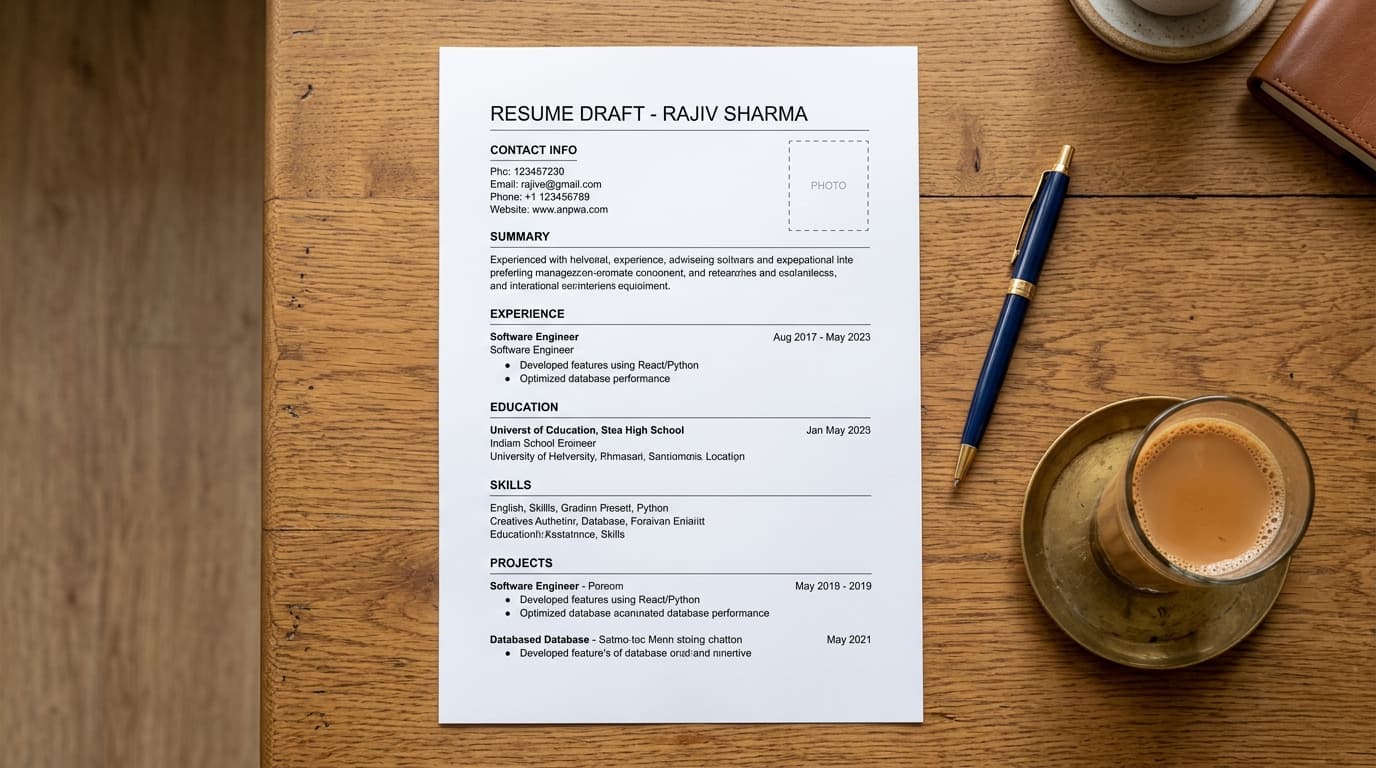
Pick up a random resume from an Indian college campus placement cell, and you will almost certainly see a bottom section containing these lines:
Father's Name: Late Sh. Ramesh Kumar
Date of Birth: 14/08/2003
Marital Status: Single
Nationality: Indian
Permanent Address: Flat 402, Shanti Nagar, Lane 3, Pune - 411014
Declaration: I hereby declare that the above information is true to the best of my knowledge and belief.
Place: Pune                                                    [Signature]
Date: 15/10/2026                                              Aarav Sharma
In the private corporate sector in 2026, this entire block of text is not only completely obsolete—it actively hurts your job application. It consumes up to 25% of your single page, exposes your sensitive personal data to identity theft, triggers algorithmic parsing errors in applicant tracking systems (ATS), and introduces subconscious hiring bias.
Yet, candidates hesitate: What if the company rejects me for not signing a declaration? Doesn't TCS require my date of birth? What about jobs in Dubai or government PSUs?
This guide explains why Indian resumes carry these legacy biodata habits, provides an employer-by-employer breakdown of what to include, shares the exact wording for declarations when legally required, and outlines critical privacy rules to protect your personal identity.
Why Indian resumes still carry 1990s biodata habits
The presence of photos, father's names, and declaration statements on Indian resumes is a cultural hangover from the pre-internet era:
- The Colonial & PSU Legacy: In the 1980s and 1990s, the primary employer for Indian graduates was the public sector (nationalized banks, railways, state civil services). Government recruitment mandated physical biodata forms with stamped declarations and family lineage to verify statutory reservation eligibility and prevent identity impersonation.
- Local Cyber Cafe & Typing Shop Templates: When internet job searching began in the 2000s, local cyber cafes created basic Microsoft Word templates by copying physical government biodatas. Those 20-year-old files were handed down through generations of college seniors and are still being circulated today.
- The Rise of Automated ATS Platforms: Modern multinational corporations (Google, Amazon, Microsoft) and Indian IT giants (TCS, Infosys, Wipro, Accenture) no longer hire via physical paper files. They use automated parsers and candidate relationship management software that parse pure text data.
Personal details by employer type: the master matrix
What you should include depends entirely on who is hiring. A single global rule does not exist; rather, different sectors operate under distinct legal and institutional standards:
| Employer Category | Photo Expected? | Date of Birth (DOB)? | Declaration Required? | Father's Name / Caste? |
|---|---|---|---|---|
| Private Tech & Startups (Swiggy, Razorpay, Google) | NO (Remove) | NO (Remove) | NO (Remove) | NEVER (Remove) |
| Indian IT Services (TCS, Infosys, Wipro, Accenture) | NO on PDF (Captured via portal profile) | NO on PDF (Captured in portal form) | NO on PDF (Confirmed via portal click) | NEVER on PDF |
| Government & PSUs (UPSC, SSC, State PSC, BHEL) | YES (Passport photo) | MANDATORY | MANDATORY (Signed) | MANDATORY (Statutory) |
| Gulf & Middle East (Dubai, Saudi Arabia, Qatar) | YES (Professional headshot) | YES (Needed for work visa) | NO | NO (Include nationality & visa) |
| Aviation, Hospitality, Modeling & Front-Desk | MANDATORY (Full-length & portrait) | YES | NO | NO |
| US, UK & European Remote Companies | STRICTLY PROHIBITED | STRICTLY PROHIBITED | NEVER | STRICTLY PROHIBITED |
Note: In the United States, Canada, and the UK, Equal Employment Opportunity (EEO) laws strictly discourage or prohibit photos, dates of birth, and marital status on resumes to prevent subconscious age, racial, or gender discrimination lawsuits.
The declaration clause: when to include it vs when to delete it
The classic sentence: "I hereby declare that all the details provided above are true to the best of my knowledge and belief" is legally redundant on a modern private-sector resume.
Why you should DELETE it for private corporate jobs:
When you submit an application on a modern job portal (such as Naukri, LinkedIn, Greenhouse, or Workday), you click a mandatory legal checkbox before submitting: "I certify that all statements made in this application are true and complete." Repeating this statement at the bottom of your resume PDF consumes 4 valuable lines of vertical space that could be used for an extra capstone project bullet point.
When you MUST include a declaration:
You should only include a written declaration in two specific situations:
- When applying for Government, PSU, Banking, or Defence positions where the official recruitment notification explicitly prescribes a declaration annexure.
- When your college placement cell mandates a physical printed resume for on-campus company folders that will be signed by hand during an in-person panel interview.
Standard declaration wording (if legally required):
If an employer or college placement officer explicitly mandates a declaration, keep it compact and professional:
DECLARATION
I hereby affirm that the information provided in this document is true and accurate.

Date: [DD/MM/YYYY]                                               [Your Name]
Place: [City, State]                                            [Signature]
The photo on your resume: ATS risk vs industry expectations
A debate among Indian freshers is whether to paste a passport-sized photograph in the top-right corner of their resume.
Why photos hurt your chances in IT and corporate hiring:
- ATS Optical Extraction Scrambling: In our laboratory parsing tests across Workday and Taleo, graphic photo containers frequently cause text in adjacent columns to shift. In several instances, the parser attempted to parse binary image data, producing corrupt character strings.
- Wasted Vertical Real Estate: A standard passport photo box consumes a 2x2 inch block of space, forcing you to truncate important technical skills and project metrics.
- Subconscious Bias: Human reviewers are susceptible to unconscious cognitive biases based on appearance, attire, and demographic markers. Western tech companies often discard resumes with photos automatically to protect hiring managers from discrimination liability.
The rare exceptions where photos are required:
- Gulf & Middle East Applications: Companies in Dubai, Abu Dhabi, and Doha frequently expect a professional business headshot for visa application screening.
- Customer-Facing Service Roles: Cabin crew, hotel front-desk operations, luxury retail, and broadcast journalism explicitly screen for grooming standards.
If your role requires a photo, ensure it is a high-resolution, front-facing business headshot with neutral lighting and a plain white background. Never use casual selfies, cropped wedding photos, or social media snapshots.
Personal details checklist: keep, remove, or only-if-asked
Audit your header and footer against this reference standard:
1. Always KEEP (In Document Header):
- Full Legal Name: In 16pt–18pt bold font at the top.
- Professional Email Address: Use a clean naming convention (e.g.,
firstname.lastname@gmail.com). - Contact Phone Number: Include the India country code (
+91 98765 43210). - Current City & State: e.g.,
Bengaluru, Karnataka(indicates your current location and whether you require relocation assistance). - Clickable Links: LinkedIn profile and GitHub (for developers) or portfolio link (for designers and writers).
2. Always REMOVE (Private Corporate Applications):
- Father's Name & Occupation: Zero relevance to your individual competency.
- Date of Birth & Age: Irrelevant for merit-based hiring; captured separately in online onboarding forms.
- Marital Status & Gender: Opens the door to illegal personal discrimination.
- Religion, Caste & Community: Strictly private personal identity markers.
- Languages Known (if only regional): In software engineering, your programming languages matter; your spoken mother tongue is irrelevant unless the role is for client-facing translation or regional customer support.
- Permanent Home Address: House numbers, street names, and postal pin codes waste space and pose security risks.
Privacy & cybersecurity: sensitive data NEVER to put on a resume
In the modern digital hiring era, candidate resumes circulate across third-party portals, recruiter WhatsApp groups, and email threads. Listing sensitive identity numbers on your resume exposes you to severe cybersecurity, financial fraud, and identity theft risks.
Never, under any circumstances, include the following on a resume:
- Aadhaar Card Number: Your 12-digit Aadhaar number can be leveraged for unauthorized biometric authentication or identity impersonation.
- Permanent Account Number (PAN): Your PAN is a financial tax identifier that should only be disclosed during formal post-offer background verification (BGV).
- Passport Number: Never disclose your international passport number on a publicly circulating resume PDF.
- Bank Account Details or UPI Handles: Completely unnecessary until HR payroll onboarding begins after an offer letter is signed.
- Exact Full Residential Address: Listing your exact house number and street on a document uploaded to public job boards like Naukri compromises personal and physical privacy. State only your city and state (
Pune, Maharashtra).
For a broader analysis of how to structure your resume without legacy clutter, read our pillar guide: Resume Format for Freshers in India.
Frequently Asked Questions
Is a declaration mandatory in a fresher resume in India?
No. For private corporate jobs, IT services (TCS, Infosys, Wipro, Accenture), and tech startups, a declaration clause is completely obsolete. Digital job portals capture your legal consent via mandatory submission checkboxes. Include a written declaration only if applying to government PSUs or if explicitly required by your campus placement officer.
Should I put my photo on my resume in India?
Do not include a photo if you are applying for software engineering, finance, data analytics, or corporate roles. Photos introduce ATS parsing glitches, consume critical vertical space, and introduce subconscious recruiter bias. Photos are only appropriate for aviation, hospitality, and Gulf region applications.
Should freshers include their Date of Birth (DOB) on a resume?
No. In private corporate hiring, your date of birth is irrelevant; hiring managers evaluate your graduation year and technical competencies. Mass recruiters and corporate HR departments capture your exact date of birth during formal online registration for statutory background verification.
Why do old Indian resume templates include father's name?
Listing a father's name is a legacy habit carried over from 1980s colonial government biodatas, where parental identity was used to verify domicile and land records. It has zero place on a modern 2026 private-sector resume.
Can an ATS read resumes that contain photos and tables?
Many enterprise parsers (like older versions of Taleo or Workday) struggle with photos and embedded tables. Photos can corrupt character coordinate mapping, and tables often cause horizontal scanners to interleave text between cells. Stick to a clean, text-based single-column layout.
Format your privacy-safe resume on ResumeCopy
Ensure your resume follows modern 2026 professional standards:
- Build Your ATS Resume Free — Clean, single-column templates with zero legacy clutter and 100% browser-only privacy.
- Check Your ATS Score Free — Audit your document across 10 deterministic parsing dimensions.
- Explore Freshers Career Hub — Find complete placement guides, sample layouts, and interview strategies.
Primary Sources & Further Reading
- Information Technology Act, 2000 & Digital Personal Data Protection Act (DPDPA), India (2023): Personal Identifiable Information (PII) Protection Standards.
- U.S. Equal Employment Opportunity Commission (EEOC): Prohibited Employment Policies/Practices Regarding Age, Gender, and Demographic Indicators.
- NASSCOM National Skills Registry (NSR): Candidate Onboarding and Identity Verification Security Protocols.
- SHRM India Workplace Guidelines: Eliminating Demographic Bias in Early-Career Recruitment Screening.