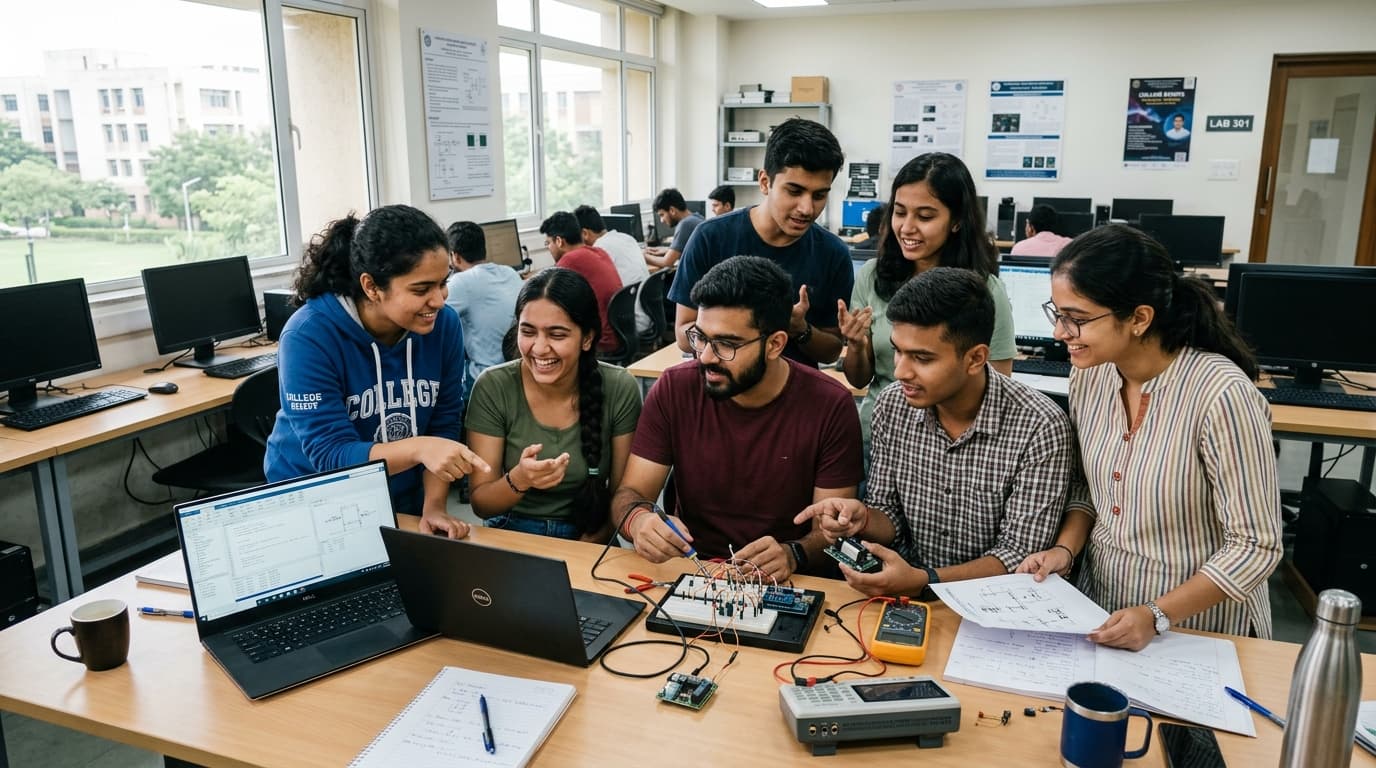
For an entry-level candidate or college graduate with zero full-time corporate experience, your Projects section is the single most critical differentiator on your entire resume.
When an engineering manager, finance director, or marketing lead opens a fresher resume, they already know you attended college lectures. What they are desperate to discover is whether you can actually build, analyze, or execute. A candidate who can demonstrate how they built a real-world software system, audited a balance sheet in Tally, or conducted an empirical field survey will always beat a candidate who merely lists classroom courses.
Yet, over 80% of freshers describe their projects like passive school homework: "Worked on an e-commerce website for college final year project using HTML and CSS." This tells the recruiter nothing about your technical decisions, your architecture, or the results you achieved.
This guide provides the proven 4-part project bullet formula, a comparison table of weak vs strong bullets, 12 comprehensive project examples spanning engineering, commerce, management, science, and humanities, and the exact techniques to quantify achievements when you do not have business sales revenue.
Why projects matter most on a fresher resume
In corporate talent acquisition, recruiters evaluate candidates through the lens of risk reduction. Hiring a fresher is inherently risky because the candidate has no verified track record of delivering workplace value under deadlines.
A strong projects section de-risks your application in three distinct ways:
- It proves practical tool mastery: Anyone can type "Python" or "Advanced Excel" in a skills list. A capstone project proves you know how to import libraries, clean dirty datasets, structure schemas, and debug run-time errors.
- It serves as your technical interview script: In 9 out of 10 fresher technical interviews, the interviewer points directly to your capstone project and asks: "Walk me through the architecture of this project and why you chose this specific tech stack."
- It levels the playing field between college tiers: A student from a Tier-3 engineering college with an exceptional, deployed open-source project will frequently outperform an Ivy League or Tier-1 student who only completed mandatory textbook lab assignments.
The 4-part project formula
Every project on your resume should follow a standardized 4-part architectural blueprint:
[PROJECT TITLE] | [TECH STACK & TOOLS USED] | [TIMELINE]
Live Demo / GitHub Link: github.com/username/project-repo

• Bullet 1 (The Problem & Scope): What real-world challenge did the project address, and what was your specific role?
• Bullet 2 (Technical Execution & Architecture): What specific frameworks, database models, or analytical methodologies did you engineer?
• Bullet 3 (Quantified Impact & Result): What was the measurable outcome, performance efficiency, dataset size, or user adoption?
The bullet formulation standard: Google XYZ Formula
Every individual bullet point within your project must follow Google’s renowned hiring formula: $$\text{Accomplished [X], as measured by [Y], by doing [Z]}$$
- [X] What you accomplished: "Accelerated search response times"
- [Y] The measurable benchmark: "by 45% (sub-120ms latency)"
- [Z] The method or tool used: "by implementing Redis in-memory caching and compound PostgreSQL indexes."
You can generate quantified bullets automatically using our Bullet Point Generator.
Weak vs strong project bullets: the comparison table
See how applying the 4-part formula transforms passive college homework into enterprise-grade engineering credentials:
| Project Domain | Weak Bullet (Rejected as Generic) | Strong Bullet (Wins Interviews) | Why the Strong Version Wins |
|---|---|---|---|
| Web Development | Made an online food ordering website using React and Node.js for final year. | Architected responsive food delivery web app using React, Node.js, and PostgreSQL; built 14 REST endpoints with Stripe mock payment integration, handling 200+ simulated orders. | States exact backend technologies, specific endpoint volume, and verified payment gateway integration. |
| Machine Learning | Worked on sentiment analysis using Python and machine learning algorithms. | Engineered an NLP sentiment classification pipeline in Python (Scikit-Learn, NLTK) across 45,000 Amazon product reviews, achieving 91.4% F1-score via TF-IDF vectorization. | Cites specific dataset volume (45,000 reviews), machine learning metric (F1-score), and algorithmic technique. |
| Finance & Accounting | Did financial statement analysis of Reliance Industries for college assignment. | Conducted 3-year horizontal and vertical ratio analysis on published annual reports of Reliance Industries in MS Excel; modeled DCF valuation projections across 3 sensitivity scenarios. | Uses professional corporate finance vocabulary (DCF, horizontal/vertical ratios, sensitivity modeling) instead of "college assignment." |
| Marketing / Business | Conducted market research survey on consumer preferences for electric vehicles. | Surveyed 350+ urban commuters using structured questionnaires; analyzed consumer EV adoption barriers in SPSS, identifying charging infrastructure as the primary objection (64%). | Demonstrates real empirical rigor (350+ sample size), statistical tooling (SPSS), and a concrete strategic insight. |
12 Real project examples across all major streams
Below are 12 copy-ready project entries spanning engineering, computer applications, commerce, management, sciences, and humanities:
1. B.Tech Computer Science: Full-Stack Web Application
Campus Event Booking & Ticketing Portal | React.js, Spring Boot, PostgreSQL, Docker
GitHub: github.com/username/campus-event-portal | Live Demo: campus-tickets.vercel.app
• Architected a responsive, role-based ticketing platform utilized by 1,400+ college students across 12 campus technical societies.
• Developed 16 RESTful API endpoints in Spring Boot with Spring Data JPA; implemented JWT authentication and BCrypt password encryption.
• Containerized microservices using Docker and deployed on AWS EC2, maintaining sub-150ms average query latency via connection pooling.
2. B.Tech Computer Science / AI: Machine Learning Pipeline
Healthcare Diabetic Retinopathy Detection Model | Python, PyTorch, OpenCV, Flask
GitHub: github.com/username/retinopathy-detection-ai
• Built a deep convolutional neural network (ResNet-50) in PyTorch to classify retinal fundus images across 5 disease severity stages.
• Preprocessed and augmented 12,000+ medical images using OpenCV (Gaussian blur, contrast normalization), expanding dataset by 3x.
• Achieved 89.2% validation accuracy and 0.92 ROC-AUC; deployed an interactive Flask inference API processing image scans in under 1.8 seconds.
3. Electronics & Communication (ECE): IoT & Embedded Telemetry
Automated Industrial Temperature & Gas Telemetry System | Embedded C, ESP32, MQTT, MySQL
GitHub: github.com/username/industrial-iot-telemetry
• Engineered an industrial environmental monitoring system utilizing ESP32 microcontroller and MQ-135/DHT22 sensor arrays.
• Programmed low-power asynchronous telemetry pipelines in Embedded C using MQTT protocol, reducing packet transmission loss by 28%.
• Developed a local Python dashboard logging real-time sensor streams into MySQL, triggering automatic audio-visual hazard alarms.
4. Mechanical Engineering: CAD Modeling & Finite Element Analysis (FEA)
Automotive Disc Brake Rotor Thermal Stress Simulation | SolidWorks, ANSYS Mechanical
• Designed a ventilated disc brake rotor geometry in SolidWorks, optimizing curved cooling vane profiles for heat dissipation.
• Conducted transient thermal and structural FEA simulations in ANSYS under 100 km/h emergency braking deceleration conditions.
• Identified critical thermal stress concentrations, recommending material substitution (Grey Cast Iron to Carbon-Ceramic) that lowered peak surface temperatures by 18%.
5. Civil Engineering: Structural Analysis & Cost Estimation
Seismic Structural Design & Cost Estimation of a G+5 Commercial Building | STAAD.Pro, AutoCAD
• Modeled and analyzed a 6-story reinforced concrete frame structure in STAAD.Pro adhering to Indian Standard seismic codes (IS 1893:2016).
• Calculated dead, live, and wind load combinations across 42 structural joints; designed column and beam reinforcement schedules.
• Prepared detailed Bar Bending Schedules (BBS) and bill of quantities (BOQ) in AutoCAD and MS Excel, estimating material costs at ₹2.4 Crores.
6. BCA / MCA: Database Management & Business Portal
Retail Inventory & Supply Chain Management System | Java, JavaFX, MySQL, JDBC
GitHub: github.com/username/retail-inventory-system
• Built a standalone desktop inventory management system supporting multi-tier product cataloging and real-time stock depletion alerts.
• Designed a 3NF relational database schema in MySQL comprising 12 tables with foreign key constraints, indexes, and stored procedures.
• Authored complex SQL queries (aggregate functions, multi-table JOINs) to generate automated daily sales and profit margin reports.
7. Bachelor of Commerce (BCom): GST & Accounting Audit Simulation
Corporate GST Reconciliation & Input Tax Credit (ITC) Audit | Tally Prime, MS Excel
• Audited 350+ simulated vendor purchase invoices against outward supply GSTR-2B data for a manufacturing SME in Tally Prime.
• Identified Input Tax Credit (ITC) mismatches amounting to ₹5.2 Lakhs caused by delayed supplier filings and incorrect GSTIN entries.
• Formulated an automated Excel reconciliation macro using VLOOKUP and conditional formatting, slashing reconciliation cycle time by 40%.
8. Bachelor of Business Administration (BBA): Market Research Study
Consumer Preference & Price Sensitivity Analysis for Quick Commerce Apps | SPSS, Excel
• Formulated a structured 24-question survey analyzing consumer grocery delivery trade-offs across 420 urban working professionals.
• Executed descriptive statistical modeling and cross-tabulation in SPSS to calculate Price Elasticity of Demand across basket sizes.
• Delivered an executive research deck highlighting 10-minute delivery as the primary driver for impulse snacking purchases (71% of respondents).
9. Bachelor of Science (BSc): Bioinformatics / Lab Study
Comparative Genomic Analysis of Antibiotic Resistance Genes | Python, Biopython, BLAST
• Retrieved and analyzed 150+ bacterial plasmid genomic sequences from the NCBI GenBank database using Biopython automation scripts.
• Conducted multiple sequence alignments (MSA) with BLAST algorithms to map mutation frequencies in beta-lactamase resistance genes.
• Synthesized phylogenetic tree diagrams using MEGA software, identifying 3 conserved sequence motifs correlated with high drug tolerance.
10. Bachelor of Arts (BA): Socio-Economic Field Research Paper
Empirical Study: Impact of Direct Benefit Transfer (DBT) on Rural Education in Bihar | STATA
• Designed a field survey evaluating educational expenditure patterns across 180 rural households receiving government direct cash transfers.
• Cleaned and analyzed cross-sectional survey data in STATA, running multivariate linear regressions to isolate confounding income variables.
• Authored a 25-page academic research paper demonstrating a statistically significant 14% increase in girls' secondary school attendance.
11. MBA: Live Corporate Consulting Capstone
Omnichannel Supply Chain Distribution Strategy | Live Capstone Project
• Evaluated end-to-end warehouse fulfillment bottlenecks for a regional FMCG distributor operating across 4 Tier-2 distribution centers.
• Conducted ABC inventory classification analysis in MS Excel across 2,400 SKUs, identifying that 18% of products generated 76% of warehouse holding costs.
• Formulated a hub-and-spoke replenishment model projected to decrease stock-out occurrences by 22% and lower inventory holding costs by ₹14 Lakhs.
12. UI/UX Design: End-to-End Product Case Study
Healthcare Telemedicine Mobile App Redesign | Figma, Maze, Miro
Case Study Link: behance.net/username/telehealth-redesign
• Conducted 12 semi-structured user interviews with elderly patients (aged 55+) to uncover usability frictions in remote doctor booking.
• Developed user personas, journey maps, and wireframe prototypes in Figma, introducing high-contrast typography and simplified 3-tap appointment flows.
• Ran unmoderated remote usability tests with 20 participants via Maze, measuring a 42% reduction in task completion time and zero navigation drop-offs.
Raw AI bullet vs human-edited final version
Many students make the mistake of asking ChatGPT to write their resume bullets and copying the raw output directly. Generic AI text is packed with recognizable buzzwords ("spearheaded, revolutionized, seamless, innovative") that modern recruiters instantly recognize as low-effort filler.
See how a student takes raw AI output and edits it into an authentic, believable technical bullet:
Raw ChatGPT Output (Robotic & Vague):
"Spearheaded the innovative development of a cutting-edge, robust e-commerce platform that revolutionized the seamless user experience and unlocked tremendous transactional efficiency."
Why the raw output fails:
- Zero technical substance (what language was used? what database?)
- Meaningless fluff adjectives (cutting-edge, seamless, revolutionary)
- Unbelievable claims ("revolutionized user experience" on a student project)
Human-Edited Final Version (Technical, Factual & Grounded):
"Developed an e-commerce catalog web app in React.js and Node.js; designed a PostgreSQL schema with 8 normalized tables and implemented JWT authentication, handling 300+ simulated concurrent user sessions."
How to handle group projects on your resume
Most engineering and college capstones are completed in teams of 3 to 5 students. A common interview trap occurs when a candidate claims credit for an entire system, and the interviewer begins questioning them on a database module built by their teammate.
Follow these rules for team projects:
- State your exact ownership domain: Explicitly state what part of the system you engineered:
- "Backend API Architecture (Team Lead in a 4-person team)"
- "Lead UI Designer & Frontend Developer (Group of 3)"
- Never claim your teammate's code: If your partner trained the machine learning model while you built the React frontend and Flask API wrapper, write: "Engineered the responsive React dashboard and Flask REST API consuming the backend ML classification pipeline."
- Highlight collaborative engineering tools: Mention your team workflow: "Managed version control, branch merging, and pull request reviews across a 4-person team using GitHub."
No sales numbers? How to quantify achievements anyway
Students often protest: "My college project has no real users or revenue—how can I include numbers?"
You do not need commercial revenue metrics. You can quantify engineering, operational, and data scale:
- Execution Speed & Latency: "Reduced API response latency from 320ms to 140ms by implementing database indexing."
- Dataset Scale: "Trained model across a dataset of 25,000 labeled images" or "Cleaned 4,500 rows of dirty financial survey data in Python."
- Test Coverage: "Wrote 35 unit test suites in JUnit, achieving 88% codebase code coverage."
- Endpoint / Feature Volume: "Built 14 RESTful API routes with full error-handling middleware."
- Sample Size: "Surveyed 250 college students across 4 academic departments."
- Time Saved: "Automated invoice reconciliation, reducing manual calculation time from 4 hours to 15 minutes."
For more strategies on non-financial metrics, read our comprehensive guide: How to Quantify Resume Achievements (Even if You Hate Math).
GitHub, Behance & Google Drive links that actually count
Adding a link to your project is critical proof of authentic work, but broken or empty links destroy recruiter trust:
- Clean up your GitHub repository: Never link to a repo that contains only code without a description. Ensure every repository contains a comprehensive
README.mdfile featuring:- A 2-sentence summary of what the software does
- A screenshot or GIF of the running application
- Prerequisites and step-by-step setup commands (
npm install,docker-compose up) - An architectural diagram explaining data flow
- Keep code public: Verify that your repository is set to Public. Having a recruiter hit a
404 Not Foundpage is an instant disqualification. - Use hyperlinked text: Instead of printing ugly 80-character raw URLs (
https://github.com/john-doe-1234/my-awesome-final-year-capstone-project-v2), format links cleanly:GitHub: github.com/username/project-repoor[Live Demo ↗].
Frequently Asked Questions
How many projects should a fresher list on their resume?
A fresher should list 2 to 3 high-impact projects. It is far better to feature two deeply understood projects with comprehensive bullet points, verified GitHub links, and clean architecture than to crowd your page with five shallow classroom assignments.
Can non-tech students include a projects section on their resume?
Yes, absolutely. Commerce students can feature financial statement analysis or GST audits; management students can feature market research surveys and brand pitch decks; and humanities students can feature investigative articles or econometric research papers. Any structured initiative where you applied tools to solve a problem counts as a project.
Where should the projects section go on a fresher resume?
For freshers with zero corporate experience, the Projects section should be placed prominently in the top half of the document, immediately following Education and Technical Skills. For experienced professionals with 3+ years of full-time work, projects are typically moved beneath the Work Experience section.
Should I include final year college projects on my resume?
Yes. Your final year capstone project is often your largest and most technically complex academic endeavor. Detail your specific contributions, the tools and frameworks utilized, and the measurable outcome or grade awarded.
What if my college project was just a tutorial clone?
If you built a standard tutorial project (like a basic To-Do list or weather app), upgrade it before putting it on your resume. Add complex features: user authentication with JWT, relational database storage, rate limiting, or Docker containerization. Transforming a simple tutorial into a production-grade application demonstrates true engineering initiative.
Craft high-impact project bullets on ResumeCopy
Turn your college projects into interview-winning achievements:
- Generate Google XYZ Bullets Free — Transform passive duties into quantified impact statements.
- Check Your ATS Score Free — Verify that your project descriptions parse cleanly into recruiting databases.
- Explore Freshers Career Hub — Find complete placement guides, sample layouts, and interview strategies.
Primary Sources & Further Reading
- Google Engineering Recruitment Standards: The Google XYZ Resume Bullet Formulation Framework (2025).
- GitHub Education Report: What Open Source and Capstone Signals Technical Hiring Managers Look For in Entry-Level Engineering Repositories.
- NACE (National Association of Colleges and Employers): Evaluating Experiential Projects vs Traditional Coursework in Graduate Hiring.
- ACM (Association for Computing Machinery): Curriculum Guidelines for Undergraduate Programs in Computer Science: Capstone Best Practices.